 English
 한국어
한국어 বাংলা ভাষার
 हिन्दी
 Türkçe
 русский

Top Recycled Polyester Yarn Manufacturers Guide: Production & Impact
As leading recycled polyester yarn manufacturers, understanding how sustainable synthetic fiber is produced helps textile buyers balance eco-friendliness with superior performance. Recycled polyester yarn (also known as rPET yarn) is a synthetic fiber produced from post-consumer PET plastic bottles or post-industrial waste, delivering comparable tensile strength and durability to virgin polyester while using 59% less energy and reducing carbon emissions by 32% to 75%.
For textile purchasing managers and custom manufacturers sourcing reliable sustainable yarns, Sinrylion brings over 40 years of manufacturing heritage established since March 1983, providing GRS-certified, ISO9001-certified, and Oeko-Tex Standard 100 eco-friendly yarn solutions engineered for global compliance and demanding textile applications.
📌Key Takeaways
-
Environmental Impact: Manufacturing recycled polyester yarn consumes 59% less energy and cuts CO2 emissions by 32% to 75% compared to virgin PET production.
-
Efficient Process: It takes approximately 25 to 30 PET bottles to manufacture 1 kg of high-tenacity rPET yarn through mechanical recycling.
-
Performance Parity: Properly processed rPET yarn achieves standard tenacity levels of 4.5 to 6.5 g/denier, making it fully interchangeable with virgin polyester across weaving, knitting, label, and ribbon applications.
-
Essential Certification: The Global Recycled Standard (GRS) requires a minimum of 20% recycled content for product certification and 50% or more to display the official GRS logo.
-
Scale & Reliability: Operating over 400 advanced machines with a daily production capacity of 20 tons, Sinrylion provides consistent batch-to-batch quality and full supply chain traceability.
The Professional Manufacturing Process of Recycled Polyester Yarn
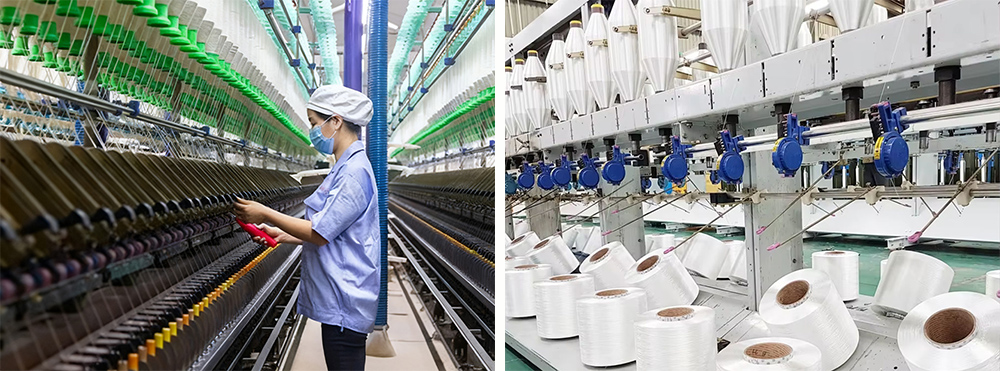
The production of recycled polyester yarn via mechanical recycling follows a highly controlled physical transformation sequence to convert plastic waste into continuous filament threads:
-
Post-Consumer PET Bottles ➔ Sorting & Washing ➔ Flake Shredding (5-10mm) ➔ High-Temp Extrusion (~280°C) ➔ POY Spinning & Twisting ➔ Finished rPET Yarn
From Plastic Waste to High-Tenacity Filaments
Converting discarded plastic bottles into industrial-grade textile filaments requires rigorous mechanical processing steps.
-
Step 1: Collection and Sorting: Post-consumer PET bottles or industrial wastes are collected and separated by color, polymer type, and purity. Transparent clear bottles are prioritized for premium bright and white yarns.
-
Step 2: Cleaning and Decontamination: Labels, caps, adhesives, and chemical residues are eliminated through intensive hot washing, friction separation, and chemical baths.
-
Step 3: Shredding into Flakes: Decontaminated PET plastic is shredded into uniform flakes measuring 5 to 10 mm to ensure balanced melting during extrusion.
-
Step 4: High-Temperature Extrusion: Clean flakes are dried, melted at approximately 280°C, and extruded through micro-hole precision spinnerets to create continuous filaments.
-
Step 5: Spinning, Drawing, and Twisting: Filaments pass through POY spinning equipment, draw-twisting machines, and twisting frames to align polymer chains, enhancing tensile strength and physical durability.
Overcoming Filament Degradation in Mechanical Recycling
Mechanical recycling subjects polyester polymers to repeated thermal cycles, which can cause thermal degradation and shorten molecular polymer chains. Inconsistent feedstock quality leads to low tensile tenacity, high breakages on weaving looms, uneven dye absorbency, and excessive fabric pilling.
To counteract material degradation, Sinrylion utilizes over 400 specialized machines—including POY spinning equipment, draw frames, warping machines, and roughly 200 dedicated twisting machines. Precision tension control during draw-twisting maintains filament alignment, yielding consistent denier uniformity and high tensile stability across all production batches.
💡 Frequently Asked Questions
Q: What is the manufacturing process of recycled polyester yarn?
A: The process involves collecting post-consumer PET bottles, sorting, washing, shredding them into 5–10 mm flakes, melting at roughly 280°C, extruding filaments through spinnerets, and draw-twisting them into high-tenacity continuous yarns.
Why Global Buyers Prefer Recycled Polyester Yarn
Textile brand owners and procurement agents increasingly specify recycled polyester yarn to meet strict environmental regulations and satisfy growing international consumer demand for sustainable apparel and home goods.
Environmental Impact Comparison
| Metric | Virgin Polyester Yarn | Recycled Polyester Yarn (rPET) | Net Sustainability Impact |
| Energy Consumption | Baseline standard (100%) | 59% lower energy requirement | Significant reduction in fossil fuel usage |
| Carbon Footprint | 5.5–7.7 kg CO2e per kg | 1.5–3.0 kg CO2e per kg | 32% to 75% lower greenhouse gas emissions |
| Raw Material Source | 100% crude oil derivatives | Post-consumer PET bottles & waste | Diverts ocean-bound plastic from landfills |
| Water Consumption | Higher processing water usage | Lower overall water footprint | Reduces industrial effluent pollution |
Regulatory Drivers and Mandatory Global Mandates
Global textile manufacturing is experiencing a decisive shift toward circularity. International buyers face mounting pressures from global legislation and brand commitments:
-
EU Textile Strategy Mandates: The European Union is introducing mandatory ecodesign requirements for textiles, establishing minimum recycled synthetic content standards for goods sold across EU markets.
-
Extended Producer Responsibility (EPR): EPR schemes in France, Germany, and North America tax non-recycled textile waste, incentivizing fashion brands to adopt verified rPET inputs.
-
Global Brand Sustainability Goals: Industry leaders including Adidas, Nike, H&M, and Zara have pledged to replace virgin polyester with 100% recycled synthetic fibers across their primary product lines.
Brand Differentiation and ESG Reporting Values
Beyond regulatory compliance, adopting verified recycled yarns directly supports corporate ESG (Environmental, Social, and Governance) targets. Brands can quantify carbon savings and water offsets in annual sustainability disclosures.
Integrating GRS-certified rPET yarn enables clear consumer marketing claims, allowing finished products to feature verified eco-hangtags that justify premium retail pricing and boost customer loyalty.
💡 Frequently Asked Questions
Q: How does recycled polyester yarn benefit sustainable textile production?
A: It decreases manufacturing energy usage by 59%, slashes carbon emissions up to 75%, eliminates raw petroleum extraction, and enables textile brands to comply with mandatory international recycling laws.
Four Decades of Sinrylion Expertise Securing Premium Recycled Yarns
Founded in March 1983, Sinrylion is a trusted Chinese yarn manufacturer with over 40 years of industry experience. Sinrylion has built an international reputation across Fujian, Guangdong, Zhejiang, Hong Kong, Europe, and Southeast Asia.
Sinrylion Factory Profile
| Key Parameter | Factory Capability & Data |
| Established Year | March 1983 (40+ Years Manufacturing History) |
| Workforce | 101–200 Professional Employees |
| Daily Capacity | 20 Tons / Day |
| Annual Output | Over 2,000 Tons (High-Grade Polyester) / 8,000 Tons (Regular Polyester) |
| Equipment Scale | 400+ Units (POY Spinning, Twisting, Warping, Drawing) |
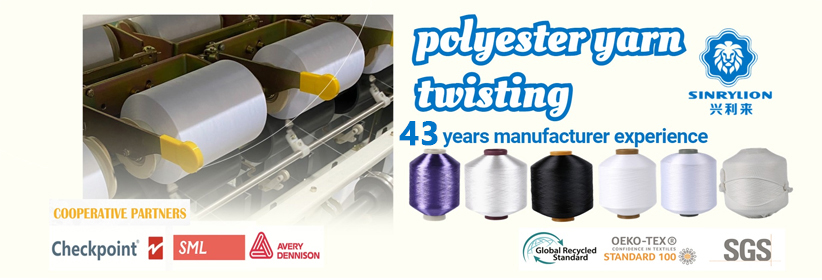
| Quality Certifications | GRS, ISO9001 Quality System, Oeko-Tex Standard 100 |
Global Quality Standards & Compliance
To serve international supply chains, Sinrylion operates under comprehensive quality management frameworks backed by leading international eco-labels:
-
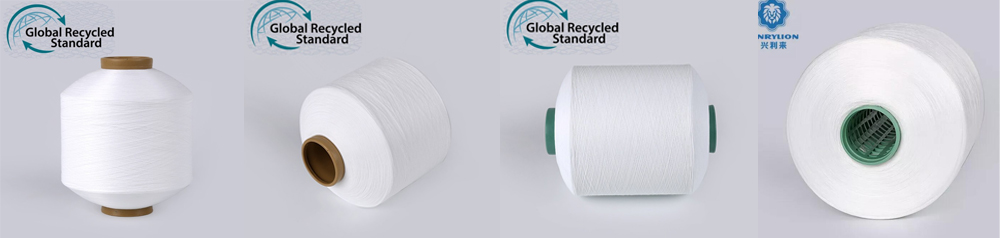
Global Recycled Standard (GRS): Verifies authentic recycled content claims and enforces strict social, environmental, and chemical tracking across the chain of custody.
-
ISO9001 Certification: Standardizes quality control management across raw material inspection, spinning, draw-twisting, packaging, and logistics.
-
Oeko-Tex Standard 100: Guarantees that finished yarns are free from harmful substances, heavy metals, formaldehyde, and toxic azo dyes.
Versatile Application Across Textile Sectors
Sinrylion specializes in custom recycled polyester twisted yarns engineered for diverse downstream manufacturing processes:
-
Woven & Printed Labels: High-density fine denier threads designed for sharp text resolution and soft skin contact.
-
Narrow Fabrics & Ribbons: High-tenacity twisted yarns ideal for luggage webbing, lanyards, and decorative gift ribbons.
-
Circular Knitting & Weaving: Even-twist yarn structures optimized for smooth feeding on high-speed circular knitting machines and shuttleless looms.
Integrated In-House R&D and Precision QC Testing
Sinrylion operates a dedicated R&D Center and Testing Center within its production facility. Every batch of recycled polyester yarn undergoes rigorous physical testing before shipment, including tensile strength measurement, Uster evenness analysis, twist-per-meter (TPM) verification, and colorfastness evaluations. This internal quality framework ensures zero defect propagation to client manufacturing lines.
💡 Frequently Asked Questions
Q: Why choose GRS certified recycled polyester yarn suppliers?
A: GRS certification ensures complete supply chain transparency via official Transaction Certificates (TCs), verifies authentic recycled bottle percentages, and enforces strict ZDHC chemical management during production.
Practical Guide to Selecting High Quality Recycled Polyester Yarn
Selecting the right yarn specification prevents yarn breakage, color variation, and fabric defects on automated looms and knitting equipment.
Technical Specification Matrix
| Denier Range | Filament Count | Primary Textile Applications | Recommended Properties |
| 50D – 75D | Fine filaments | Woven labels, lightweight garment linings, delicate ribbons | High tenacity, soft hand-feel |
| 75D – 150D | Medium filaments | Apparel fabrics, curtain drapes, home upholstery | Balanced elongation, high wear resistance |
| 150D – 300D+ | Heavy filaments | Heavy-duty narrow fabrics, industrial webbing, luggage | Superior tensile strength (>5.0 g/d) |
Key Quality Evaluation Metrics
B2B procurement teams must evaluate key physical parameters to guarantee seam strength and operational efficiency:
-
Tenacity & Elongation: Target a tenacity range of 4.5 to 6.5 g/denier with an elongation rate of 15% to 40% to withstand high-speed mechanical tension.
-
Uster Evenness (CV%): Lower CV percentage values indicate uniform thread thickness, preventing thick/thin places in woven fabrics.
-
Colorfastness & Dope Dyeing: Verify ISO 105 compliance for washing, rubbing, and light fastness. Sinrylion offers over 1,000 bright, dope-dyed color options (solution-dyed yarn), providing exceptional batch-to-batch color consistency while eliminating traditional wet dyeing and minimizing water pollution.
Dope-Dyed Yarns: The Eco-Friendly Solution for Bright Colors
Unlike traditional piece dyeing or package dyeing which consumes vast amounts of water and thermal energy, dope dyeing (solution dyeing) adds color masterbatch directly into molten polymer before extrusion.
This process locks pigment inside the fiber core, delivering outstanding UV resistance and washing colorfastness (Grade 4.5+). Dope-dyed recycled polyester yarn cuts water usage by 80% and reduces chemical discharge, aligning perfectly with zero-discharge goals.
Procurement Verification Checklist & Facility Audits
Before finalizing purchase orders with synthetic yarn suppliers, perform these crucial verification steps:
-
Request an official GRS Transaction Certificate (TC) for your specific batch order to verify supply chain continuity.
-
Inspect laboratory test reports for tenacity, Uster evenness (CV%), and colorfastness parameters.
-
Validate third-party certifications (GRS, Oeko-Tex Standard 100) on official international databases.
-
Reject suppliers offering prices far below market rates, as this often indicates unverified post-consumer content or uncleaned PET flake inputs.
-
Conduct virtual or on-site facility audits to verify machinery scale, daily output capacity, and working condition standards.
💡 Frequently Asked Questions
Q: How to evaluate the quality of recycled polyester yarn for textile production?
A: Evaluate quality by inspecting GRS Transaction Certificates, auditing physical lab reports for tenacity (4.5–6.5 g/d) and Uster evenness (CV%), and testing colorfastness ratings under ISO 105 test standards.
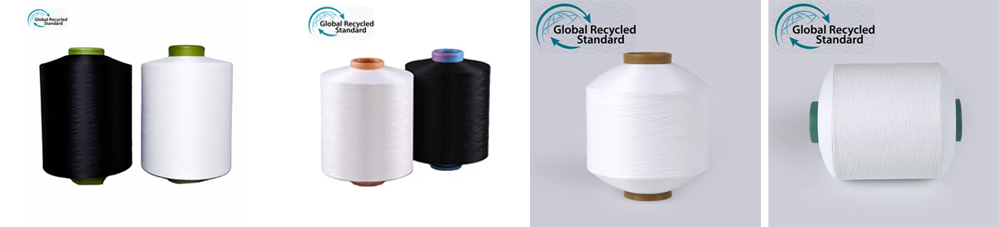
Partner with Sinrylion for High-Performance Recycled Yarns
Switching to sustainable textiles requires a reliable manufacturing partner capable of delivering consistent quality, large-scale output, and verified environmental credentials. With over 40 years of factory expertise, 400+ advanced machines, a 20-ton daily production capacity, and complete GRS, ISO9001, and Oeko-Tex Standard 100 certifications, Sinrylion provides custom recycled polyester yarn tailored to your exact textile specifications.
Contact our technical sales team today to request free samples, technical specification sheets, or a competitive quote for your next production run!
Send Inquiry




X
We use cookies to offer you a better browsing experience, analyze site traffic and personalize content. By using this site, you agree to our use of cookies.
Privacy Policy