English
 한국어
 বাংলা ভাষার
 हिन्दी
 Türkçe
 русский

Key Takeaways
- Global Recycling Standard (GRS) certification guarantees complete chain-of-custody tracking for post-consumer PET waste, requiring at least 20% recycled material for product certification and 50% for consumer hangtag labeling.
- Textile procurement managers must verify the supplier's Scope Certificate (SC) against the official Textile Exchange online database and secure shipment-specific Transaction Certificates (TCs) to prevent greenwashing penalties.
- Physical fiber authenticity verification relies on combining official certificate paperwork with laboratory testing, such as Py-GC/MS spectroscopy, differential scanning calorimetry (DSC), and intrinsic viscosity (IV) checks.
- Sinrylion delivers reliable GRS-certified supply chains backed by 40+ years of spinning expertise, 400+ advanced machines, and a 20-ton daily production capacity.
Global textile buyers face unprecedented scrutiny under stringent ESG regulations, extended producer responsibility (EPR) laws, and anti-greenwashing policies across Europe and North America. Procurement managers seeking high-performance recycled polyester yarn must ensure every pound of synthetic fiber is legally compliant and fully traceable. Sourcing from unverified recycled polyester yarn suppliers exposes fashion brands, industrial weavers, and label manufacturers to severe legal penalties, customs seizures, and reputation damage.
To successfully navigate these regulatory hurdles, international buyers must establish a rigorous chain-of-custody verification framework by combining digital certificate validation with physical yarn testing. Partnering with experienced recycled polyester yarn suppliers who operate fully audited direct manufacturing facilities guarantees both material compliance and technical excellence in high-volume recycled polyester yarn production.
The GRS Framework for Recycled Textiles
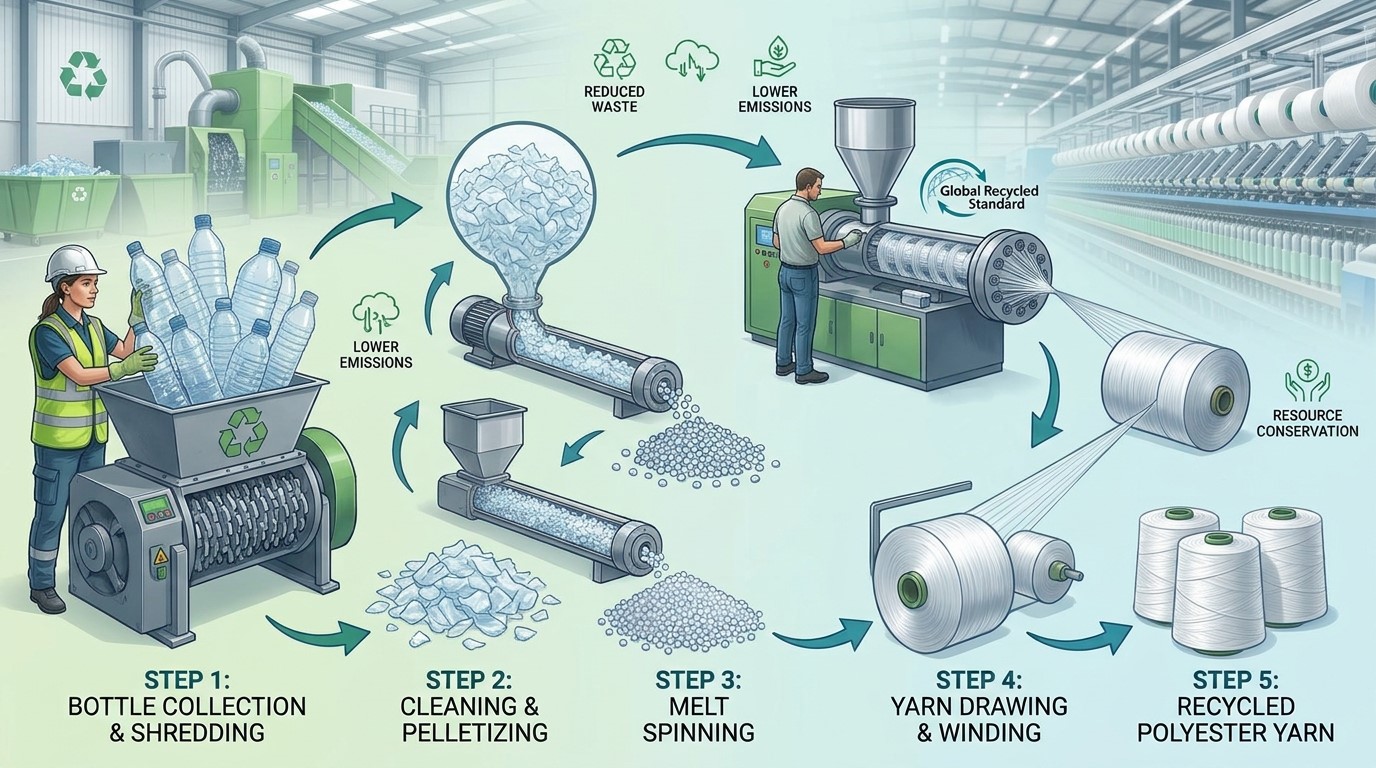
The Global Recycled Standard (GRS), managed by Textile Exchange, is an international, voluntary product standard that sets requirements for third-party certification of recycled content, chain of custody, social and environmental practices, and chemical restrictions. When sourcing high-quality recycled polyester yarn, understanding this framework allows buyers to evaluate whether prospective recycled polyester yarn suppliers adhere to real environmental metrics or merely practice deceptive greenwashing.
Understanding the specific thresholds and requirements within the GRS framework is essential for accurate product labeling and regulatory compliance across international markets:
- Minimum 20% Recycled Threshold: Necessary for product-level certification, allowing the material to be officially tracked through the chain of custody.
- Minimum 50% Logo Threshold: Required for utilizing consumer-facing GRS branding and logo hangtags on finished retail products.
- Environmental Management System (EMS): Mandates wastewater tracking, energy consumption monitoring, and strict chemical safety under ZDHC guidelines.
- Social Responsibility Auditing: Enforces fair working conditions, safe operations, and prohibition of forced labor compliant with ILO standards.
A comprehensive GRS certification gives buyers total assurance regarding both material origin and ethical production practices. Textile brands leveraging certified recycled polyester yarn from trusted recycled polyester yarn suppliers can confidently pass stringent import inspections and build long-term consumer trust across global distribution channels.
💡 Frequently Asked Questions
Q: What is the minimum recycled content required for GRS certification?
A: To earn GRS product-level certification, a material must contain at least 20% recycled content. However, to display the GRS logo and consumer-facing hangtag on the final product, the yarn must contain a minimum of 50% recycled material.
How to Spot Fake GRS Certificates
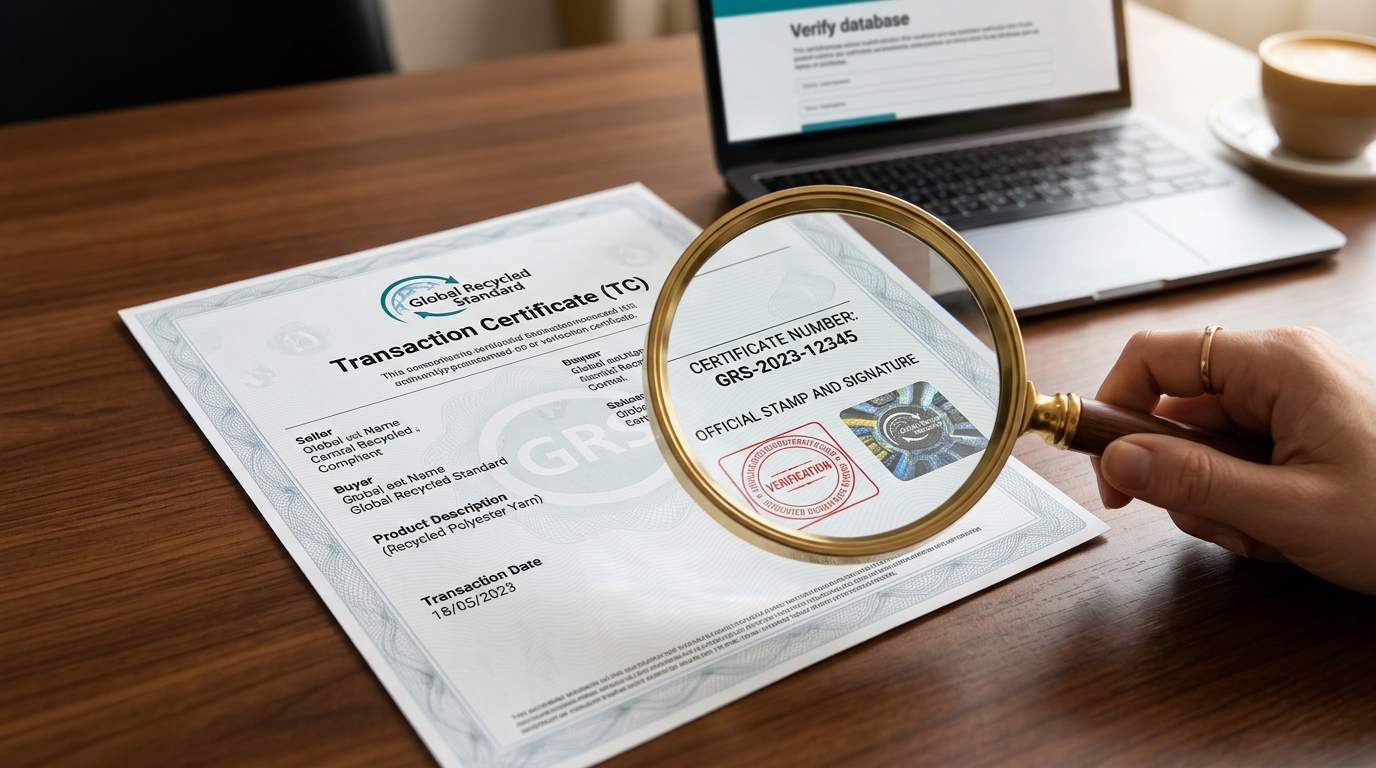
The surging demand for eco-friendly synthetic fiber has led to a rise in counterfeit scope certificates and fraudulent recycling claims across global markets. A common mistake buyers make when auditing recycled polyester yarn suppliers is relying solely on a facility Scope Certificate (SC). A Scope Certificate merely confirms that a factory has been audited; it does not prove that a specific shipment of recycled polyester yarn contains legitimate recycled post-consumer PET material.
To guarantee absolute authenticity, buyers should enforce a systematic 5-step certificate verification protocol before executing final purchase orders or releasing payments:
- Request SC and Batch-Specific TC: Obtain both the facility Scope Certificate (SC) and order-specific Transaction Certificates (TCs).
- Verify Third-Party Auditing Body: Confirm issuance from accredited international organizations such as Control Union, Intertek, SGS, or IDFL.
- Database License Lookup: Cross-reference the supplier's license number inside the official Textile Exchange online database.
- Volume Weight Matching: Validate that the net yarn weight listed on the TC matches the shipping weight on the Bill of Lading.
- Inspect Customs HTS Documentation: Verify that commercial invoices and shipping manifests correctly categorize the GRS recycled synthetic yarn.
| Document Type | Primary Purpose | Key Information Included | Verification Method |
|---|---|---|---|
| Scope Certificate (SC) | Validates facility capability | Facility address, allowed processes, valid date range | Textile Exchange Online Portal |
| Transaction Certificate (TC) | Validates specific batch shipment | Net weight, buyer/seller ID, input/output batch numbers | Issuing Certification Body Database |
Enforcing these strict verification steps ensures that unverified trading intermediaries cannot substitute lower-grade virgin fiber into certified orders. Requesting batch-level Transaction Certificates directly from reliable recycled polyester yarn suppliers guarantees the legal origin of every batch of recycled polyester yarn delivered to your spinning or weaving mills.
💡 Frequently Asked Questions
Q: What is the difference between a GRS Scope Certificate (SC) and Transaction Certificate (TC)?
A: A Scope Certificate (SC) verifies that a manufacturer is qualified to produce GRS goods. A Transaction Certificate (TC) proves that a specific shipment of yarn actually contains certified recycled material from source to delivery.
Tracing Physical Fiber vs Paper Chain
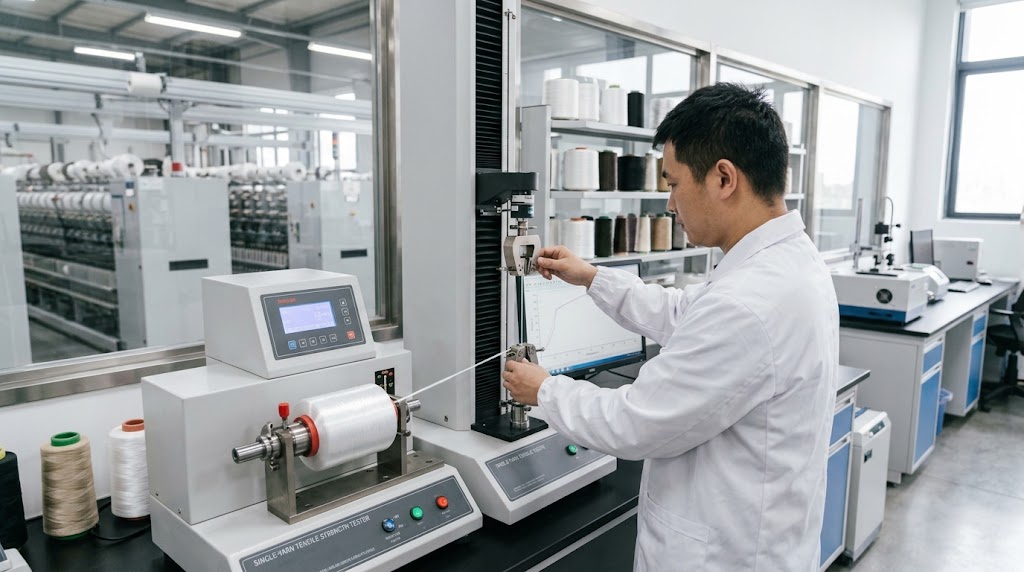
While paper documentation provides legal traceability, physical fiber verification confirms that the mechanical and physical properties of the fiber meet industrial performance standards. High-tenacity recycled polyester yarn manufactured from post-consumer water bottle flakes must match the tensile strength, color consistency, and thermal stability of virgin polyester yarn. Leading recycled polyester yarn suppliers conduct stringent laboratory testing to guarantee structural consistency across all custom production lots.
To scientifically distinguish genuine rPET fiber from virgin polyester, leading textile laboratories focus on key analytical testing parameters:
- Intrinsic Viscosity (IV): Measures molecular weight stability; high-grade rPET yarn maintains an IV between 0.65 and 0.88 dL/g for high-speed weaving.
- Py-GC/MS Spectroscopy: Detects chemical tracers, specific plasticizers, and residual catalysts present in post-consumer recycled PET flakes.
- Differential Scanning Calorimetry (DSC): Evaluates thermal behavior to confirm structural and crystalline uniformity across yarn batches.
- Tenacity Testing (g/d): Verifies break force and elongation properties to ensure performance during high-speed twisting and narrow weaving.
| Property Parameter | Virgin Polyester Yarn | GRS Recycled Polyester Yarn | Testing Standard |
|---|---|---|---|
| Tensile Strength (Tenacity) | 6.5 – 7.5 g/d | 6.0 – 7.2 g/d | ISO 2062 / ASTM D2256 |
| Intrinsic Viscosity (IV) | 0.68 – 0.85 dL/g | 0.65 – 0.82 dL/g | ASTM D4603 |
| Elongation at Break | 15% – 25% | 16% – 28% | ISO 2062 |
| Color Fastness to Washing | Grade 4.5 – 5.0 | Grade 4.0 – 5.0 | ISO 105-C06 |
Combining physical laboratory testing with Oeko-Tex Standard 100 ecological testing guarantees that recycled fibers remain free from harmful heavy metals and toxic dyes. Selecting accredited recycled polyester yarn suppliers guarantees that premium recycled polyester yarn performs identically to virgin yarn across demanding application sectors.
💡 Frequently Asked Questions
Q: Can physical testing distinguish recycled polyester yarn from virgin polyester?
A: Yes. Advanced laboratory methods like Py-GC/MS can detect specific trace elements in recycled PET bottle flakes. Thermal analysis (DSC) and intrinsic viscosity (IV) testing also help verify structural consistency.
Sinrylion GRS Manufacturing Strength
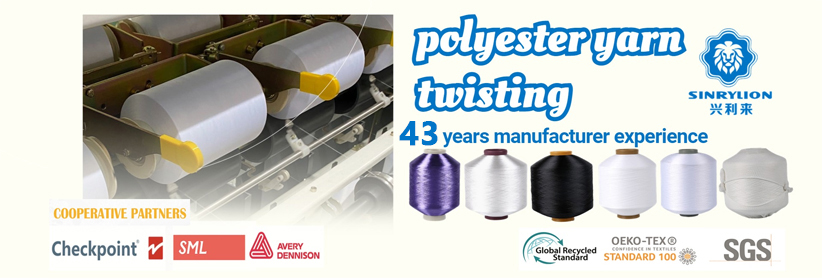
Sourcing reliable GRS-certified synthetic yarn requires a manufacturing partner with direct control over the entire production chain. Sinrylion established in March 1983, stands out among global recycled polyester yarn suppliers. As a specialized manufacturer, Sinrylion produces high-grade polyester yarn, polyester twisted yarn, recycled polyester yarn, and specialized monofilament yarns including PA6, PET, TPU, and TPEE.
Spanning four decades of technical evolution, Sinrylion operates a highly specialized facility designed for large-scale custom production:
- Decades of Industry Experience: Established in 1983, bringing 40+ years of textile spinning and twisting technical expertise.
- Robust Workforce & Turnover: Powered by 101-200 skilled employees with annual export revenues between $2 million and $5 million.
- Massive Fleet of Machinery: Operating 400+ machine sets, including POY spinning lines, doubling machines, warping units, and ~200 specialized yarn twisting machines.
- Exceptional Daily Output: Delivering 20 tons of yarn daily, yielding an annual output of over 2,000 tons of premium twisted yarn and 8,000 tons of standard polyester yarn.
- Vast Stock Color Palette: Featuring over 1,000 stock-dyed colors suited for garment labels, ribbons, footwear mesh uppers, and industrial fabrics.
With comprehensive ISO9001, Oeko-Tex Standard 100, and GRS certifications, Sinrylion provides end-to-end quality assurance. Direct factory production allows Sinrylion to outshine ordinary recycled polyester yarn suppliers, ensuring full chain-of-custody traceability for every lot of recycled polyester yarn produced.
💡 Frequently Asked Questions
Q: What guarantees does Sinrylion offer for bulk GRS yarn orders?
A: Sinrylion combines 40+ years of spinning expertise with 400+ advanced machines, producing 20 tons daily. Every shipment comes with complete GRS Transaction Certificates (TCs), ISO9001 quality compliance, and Oeko-Tex Standard 100 certification.
Strategic Sourcing Checklist for Buyers
To streamline procurement and eliminate supply chain bottlenecks, textile buyers should implement a structured audit checklist when evaluating prospective recycled polyester yarn suppliers. Having a pre-vetted sourcing protocol accelerates vendor selection while guaranteeing that all bulk orders of recycled polyester yarn conform to international sustainability guidelines.
Adhering to a standardized procurement auditing checklist helps buying offices minimize commercial delays and quality defects:
- Verify Equipment Ownership: Ensure the supplier owns spinning and twisting assets rather than acting as a non-manufacturing broker.
- Conduct Laboratory Swatch Audits: Request 1 kg yarn samples to test tenacity, shrink rates, and color fastness before bulk production.
- Establish TC Delivery Schedules: Define clear timelines for Transaction Certificate delivery, typically 10 to 15 business days post-shipment.
- Evaluate Production Scalability: Confirm the factory's daily output capacity aligns with your seasonal bulk production requirements.
Following this rigorous purchasing strategy eliminates risks associated with fake certifications and defective yarns. Buying teams can establish long-term, scalable procurement pipelines with vetted recycled polyester yarn suppliers to consistently receive verified recycled polyester yarn.
💡 Frequently Asked Questions
Q: How long does it take to receive a GRS Transaction Certificate (TC) after shipping?
A: Official TC issuance by accredited bodies like Control Union or Intertek typically takes 10 to 15 business days after final shipping documents, packing lists, and commercial invoices are submitted.